
A yellow leaf on a favorite houseplant can make your heart sink a little.
Is the plant getting too much water, too little, or something else entirely?
The answer is often in plain sight, once you know where to look.
Watering is the most common cause, and it can go wrong in both directions.
The University of Maryland Extension notes that a large percentage of houseplants are lost to overwatering and underwatering.
This guide uses its advice to help you read the signs calmly.
What the Plant Is Telling You
The extension puts it simply: the plant itself will tell you when it needs water.
When a plant is too dry, it wilts and turns a dull gray-green.
When it is too wet, it drops leaves or turns yellow.
The goal is to avoid both extremes.
The tricky part is that some signs overlap.
The extension notes that plants can also wilt when they are overwatered, not only when they are dry.
So a wilting plant sitting in wet soil needs less water, not more.
Signs of Too Much Water
- Leaves turning yellow, often starting with the lower ones.
- Leaves dropping even though the soil feels damp.
- Wilting while the soil is still wet.
- Potting mix that stays wet for many days after watering.
- A pot that feels heavy every time you lift it.
- Small dark flies hovering near the soil.
Those small flies are often fungus gnats.
The UC Statewide Integrated Pest Management Program explains that they thrive in damp potting mix.
Our fungus gnat guide shows how drier soil helps clear them.
Water left standing in a saucer or a decorative pot is a common cause of soggy soil.
The extension is clear: never let houseplants sit in water.
Signs of Too Little Water
- Wilting, with leaves turning a dull gray-green.
- Potting mix that feels dry well below the surface.
- A pot that feels very light when you lift it.
- Lower leaves that dry out and drop.
Some plants are easy to read.
The extension mentions peace lily as a plant that wilts when it needs to be watered.
Check the soil before you water, though, since wet soil can cause wilting too.
Step 1: Check the Soil, Not the Calendar
The extension advises against watering on a schedule.
A fixed schedule can give a plant too much water in one season and too little in another.
Potting mix, humidity, and temperature all change how fast a pot dries.
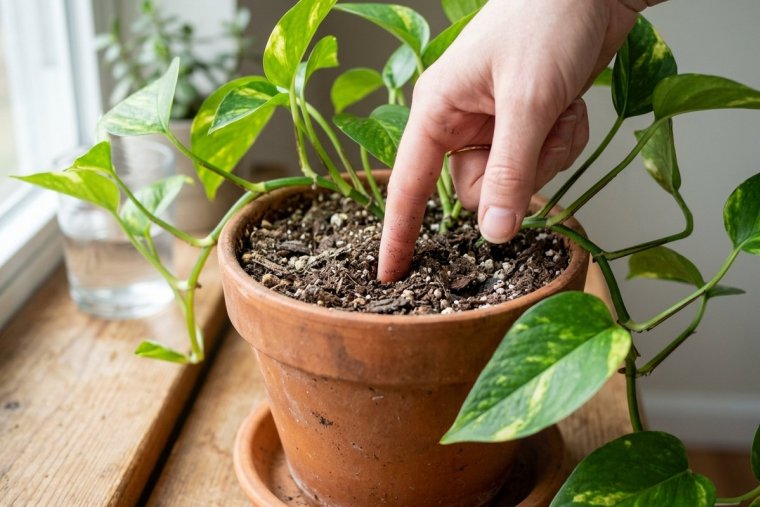
Instead, test the soil with your finger to a depth of about two inches.
If the soil is dry at that depth, the plant probably needs water.
Succulents and cacti are the main exception, since they need far less water.
If your finger cannot go two inches into the soil, the mix may be too dense or the plant may be root bound.
Step 2: Use the Lift Test
A second quick check is the weight of the pot.
Lift the plant, pot and all, just after watering to learn how heavy it feels when wet.
A few days later, lift it again.
The extension notes that a pot with dry potting mix weighs much less than one that still holds water.
After a few weeks, you will know each plant by feel.
Step 3: Water Thoroughly, Then Drain
When the plant does need water, give it a full drink.
- Water slowly from the top until water drains freely from the bottom.
- Small plants can go in the sink and return to their spot after draining.
- Empty any water left in the saucer.
- If the plant sits in a pot without holes, lift it out to drain.
Bottom watering also works.
Set the pot in a saucer of water and let the mix draw it up, then pour off what remains.
Our guide on how to water indoor plants walks through both methods.
Step 4: Check for Salt Buildup
Sometimes the amount of water is fine, but the water leaves something behind.
The extension explains that fertilizer minerals, called soluble salts, concentrate as water evaporates from the pot.
High salt levels make it harder for the plant to take up water.
Symptoms include reduced growth, brown leaf tips, dropping of lower leaves, dead root tips, and wilting.
A crusty ring of salt may form at the soil line, around the drainage hole, or on clay pots.
To prevent buildup, the extension recommends leaching the soil with clear water every four to six months.
- Remove any salt crust from the top of the soil.
- Pour clear water through the pot, at least twice the volume of the pot.
- Let it drain completely.
Leach before you fertilize, so you do not wash away fertilizer you just added.
The extension also suggests avoiding softened water, which contains more dissolved minerals.
Rainwater and the water from a dehumidifier pan are mineral-free choices it mentions.
Tap water drawn a day ahead also works, if you discard the bottom one to two inches.
Step 5: Rule Out Other Causes
Not every yellow leaf is about water.
- Old leaves: many plants let an old lower leaf go now and then as they grow.
- Light: a plant moved to a much dimmer spot may yellow and drop leaves as it adjusts.
- Pests: heavily infested plants can show yellow leaves, for example with aphids.
- A new home: a plant fresh from the store may drop a leaf or two as it settles in.
The UC program lists yellowing leaves among the signs of a heavy aphid infestation.
Check the undersides of the leaves with a magnifying glass when watering does not explain it.
Our guides to spider mites and aphids show what to look for.
Should You Remove Yellow Leaves?
A leaf that has turned fully yellow will not turn green again.
You can snip it off at its base with clean scissors once it looks unsightly.
Removing it also helps you see whether new leaves keep yellowing.
If they do, the cause is still active, so go back through the checks above.
A Calm Watering Habit
- Check the soil two inches down before every watering.
- Lift the pot to learn its wet and dry weight.
- Water thoroughly, then let it drain.
- Never leave a pot sitting in water.
- Leach the soil every four to six months.
A new plant needs one extra step, and our checklist for bringing home a new houseplant explains it.
Yellow leaves are a message, not a verdict.
Read the soil, adjust your routine, and watch the new growth.
Within a few weeks, the plant usually shows you that you found the answer.
Sources and Further Reading
- University of Maryland Extension — Watering Indoor Plants: supports the signs of too much and too little water, avoiding a schedule, the finger and lift tests, thorough watering and drainage, salt buildup symptoms, leaching, and water choices.
- UC Statewide Integrated Pest Management Program — Pest Notes: Fungus Gnats: supports the link between damp potting mix and fungus gnats.
- UC Statewide Integrated Pest Management Program — Pest Notes: Aphids: supports yellowing leaves on heavily infested plants.
- UC Statewide Integrated Pest Management Program — Pest Notes: Spider Mites: a guide to another pest that can discolor houseplant leaves.