
Some yards make gardening hard before you even start.
The soil may be rocky, heavy with clay, or soggy after every rain.
A raised bed is a calm way around these problems.
It is simply a garden bed that sits higher than the ground around it, filled with soil you choose.
Raised beds warm up sooner in spring and drain well. They keep the garden in a tidy, defined space.
They are also easier on your back and knees.
This guide follows the raised bed fact sheet from the Clemson Cooperative Extension Home and Garden Information Center.
We add a few practical tips for a first season that goes smoothly.
Why Raised Beds Work So Well
- They suit slopes, poor drainage, and shallow or rocky soil.
- The soil warms faster in spring, so planting can start a little earlier.
- You weed, water, and mulch only the bed itself.
- Soil inside the bed stays loose because nobody walks on it.
- They are a good choice for gardeners with limited mobility.
Raised beds can hold vegetables, herbs, or flowers.
Many gardeners start with one bed and add more once they enjoy the routine.
Step 1: Choose the Right Spot
Sunlight comes first.
Clemson Extension recommends a well-drained site with at least six hours of direct sun each day.
Most fruiting vegetables, such as tomatoes and peppers, do best with even more.
Next, think about water.
A bed near a hose or rain barrel is far easier to keep healthy in summer.
Finally, place the bed where you walk past it often.
Daily glances help you spot pests, dry soil, or ripe produce early.
If your area is windy, a fence or hedge nearby can offer some shelter.
Step 2: Plan the Size
Width matters more than length.
A bed should be narrow enough to reach the middle from either side without stepping in.
Clemson Extension suggests a width of about three to four feet.
If the bed sits against a wall or fence, keep it narrower. You can reach in from only one side.
Length is up to you.
An eight-foot bed is a common, manageable size for a beginner.
Leave room for paths, too.
Paths of about three to four feet between enclosed beds are comfortable for most people.
Mark the outline with stakes and string before you build anything.
It is easy to adjust string, and much harder to move a finished frame.
Step 3: Pick Your Materials
Raised beds can be framed with wood, concrete blocks, stone, or landscape timbers.
You can also skip the frame and shape a mounded bed from soil alone.
For wood frames, Clemson Extension recommends decay-resistant woods such as cedar, cypress, or redwood.
Treated lumber is another option.
The fact sheet notes that the American Wood Protection Association recommends lumber labeled UC4A or higher for garden use.
Avoid old wood of unknown origin.
Painted boards and wood that once held chemicals do not belong around food crops.
Concrete blocks are durable and simple to stack.
Their open cores can even hold small herbs or flowers.
Step 4: Prepare the Ground
Clear grass and weeds from the area first.
Then loosen the existing soil inside the frame as deeply as you can with a shovel or garden fork.
If the ground is compacted, wait until it is dry before you dig.
Working wet clay only makes it harder.
Loosening the base lets roots and water move down into the native soil below the bed.
Step 5: Fill the Bed With Good Soil
The soil you add is the heart of a raised bed.
Clemson Extension recommends a mix of good topsoil and compost.
Compost should make up about 10 to 20 percent of the total volume of soil in the bed.
Both too little and too much organic material can cause problems later.
To estimate how much soil you need, multiply length by width by height.
For example, a bed eight feet long, four feet wide, and one foot deep holds 32 cubic feet.
That is a little more than one cubic yard. One cubic yard equals 27 cubic feet.
With that mix, compost would be roughly 3 to 6 cubic feet of the total.
Before planting, test the soil.
A soil test tells you how much lime and fertilizer your plants really need.
Our guide to taking a garden soil sample walks through it step by step.
Rake the surface smooth and water it gently.
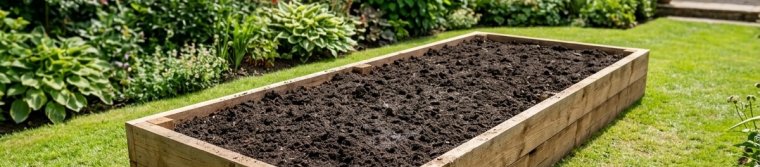
The soil will settle a little over the first week.
Building a Mounded Bed Without Sides
Not every raised bed needs a frame.
A mounded bed is shaped from soil and organic matter with a shovel and rake.
Clemson Extension suggests a finished height of four to eight inches.
The sides slope up at about a 45-degree angle, and the top is raked flat.
Paths of two to three feet between mounded beds give you room for tools.
Mounded beds cost almost nothing to make.
They do need reshaping now and then, since rain slowly wears down the edges.
Step 6: Plant in Blocks, Not Long Rows
A raised bed makes good use of every square foot.
Instead of single rows, plant in small blocks or grids.
Clemson Extension also suggests alternating crops that mature at different times.
Planting the same crop every few weeks spreads the harvest over a longer season.
Lettuce, radishes, and bush beans work well for this kind of staggered planting.
Put tall crops, such as tomatoes or trellised cucumbers, on the north side of the bed.
That way they do not shade shorter plants.
Step 7: Water and Care Through the Season
Raised beds drain well, which is a big advantage.
It also means they dry out faster than in-ground beds.
Check the soil with your finger during dry spells.
If the top inch or two feels dry, it is time to water deeply.
A soaker hose or drip line on a timer makes this routine much easier.
Clemson Extension suggests planning for irrigation when you first design the bed.
A layer of mulch helps hold moisture and keeps weeds down.
Our guide to mulching garden beds covers how deep to spread it.
Keep grass and weeds trimmed around the outside of the bed.
This limits competition and gives pests fewer places to hide.
Between Seasons: Keep the Soil Alive
Organic matter in the bed breaks down a little every year.
Top it up with compost regularly to keep the soil rich and loose.
When the bed is empty, do not leave the soil bare.
Clemson Extension recommends about two inches of pine straw, leaves, or compost, or a cover crop.
This protects the soil, holds moisture, and suppresses weeds until you plant again.
If you have a compost pile, a raised bed is the perfect place to use what it makes.
Our guide to starting a backyard compost pile explains how to begin.
A Simple First-Season Checklist
- Pick a sunny, well-drained spot close to water.
- Keep the bed about three to four feet wide.
- Use decay-resistant wood, blocks, or a simple mound.
- Loosen the ground before filling.
- Fill with topsoil plus 10 to 20 percent compost.
- Test the soil before you plant.
- Plant in blocks and water deeply during dry spells.
- Never walk on the bed.
A Calm Way to Begin
One well-placed bed is enough for a first year.
It gives you a small, manageable space to learn what grows well in your yard.
Each season the soil gets a little richer, and the work gets a little easier.
Before long, the bed becomes the calmest corner of your garden.
Sources and Further Reading
- Clemson Cooperative Extension, Home and Garden Information Center — Raised Beds: supports the site and sunlight advice, bed and path widths, materials, treated lumber guidance, the topsoil and compost mix, mounded beds, block planting, irrigation, and off-season cover.
- Clemson Cooperative Extension — Soil Testing: why to test soil before adding lime or fertilizer.
- US Environmental Protection Agency — Composting At Home: how to make compost for your beds at home.